

Your most valuable financial asset may not appear on a brokerage statement, tax return, or property record. It may be the stream of income that your knowledge, judgment, reputation, and relationships can produce over the next ten, twenty, or thirty years.
For educated professionals, that stream can fund almost everything else: retirement contributions, housing, education, insurance, family support, philanthropy, and the gradual conversion of income into lasting wealth. We diversify investment portfolios because we understand that a single asset can disappoint. Yet we often treat career income as if it were permanent, predictable, and independent of technological change.
Artificial intelligence does not have to eliminate your profession to matter financially. It may change the tasks employers value, the number of people needed for certain work, the path into senior roles, the bargaining power attached to particular skills, or the time required to find a comparable position.
The goal is not to predict whether AI will “take your job.” It is to make sure a changing job cannot take away your ability to choose.
Four numbers worth putting in context
Sources: Federal Reserve Survey of Household Economics and Decisionmaking; U.S. Bureau of Labor Statistics Employment Situation and Job Openings and Labor Turnover Survey. AI-use data were published in May 2026; labor data were released September 29 and October 2, 2026.
Your paycheck is an asset—but not a bond
In financial planning, human capital is the economic value of your ability to earn future income. Early in a career, financial assets may still be modest while human capital is substantial. As savings accumulate and retirement approaches, the balance gradually shifts.
Human capital is valuable, but it is not a guaranteed bond. Its cash flows depend on health, skills, industry demand, location, employer decisions, professional relationships, regulation, technology, and the willingness to continue working. Unlike a traded security, it cannot be sold today for a known price. Unlike a Treasury bond, it does not arrive with a stated maturity or promised payment.
This is why two people with identical salaries can have very different financial strength. One may have portable expertise, broad relationships, flexible expenses, and enough liquidity to wait for the right opportunity. The other may have a highly specialized role, large fixed obligations, employer stock, employer-dependent benefits, and only a short period before financial pressure begins directing career decisions.
AI exposure is not the same as job loss
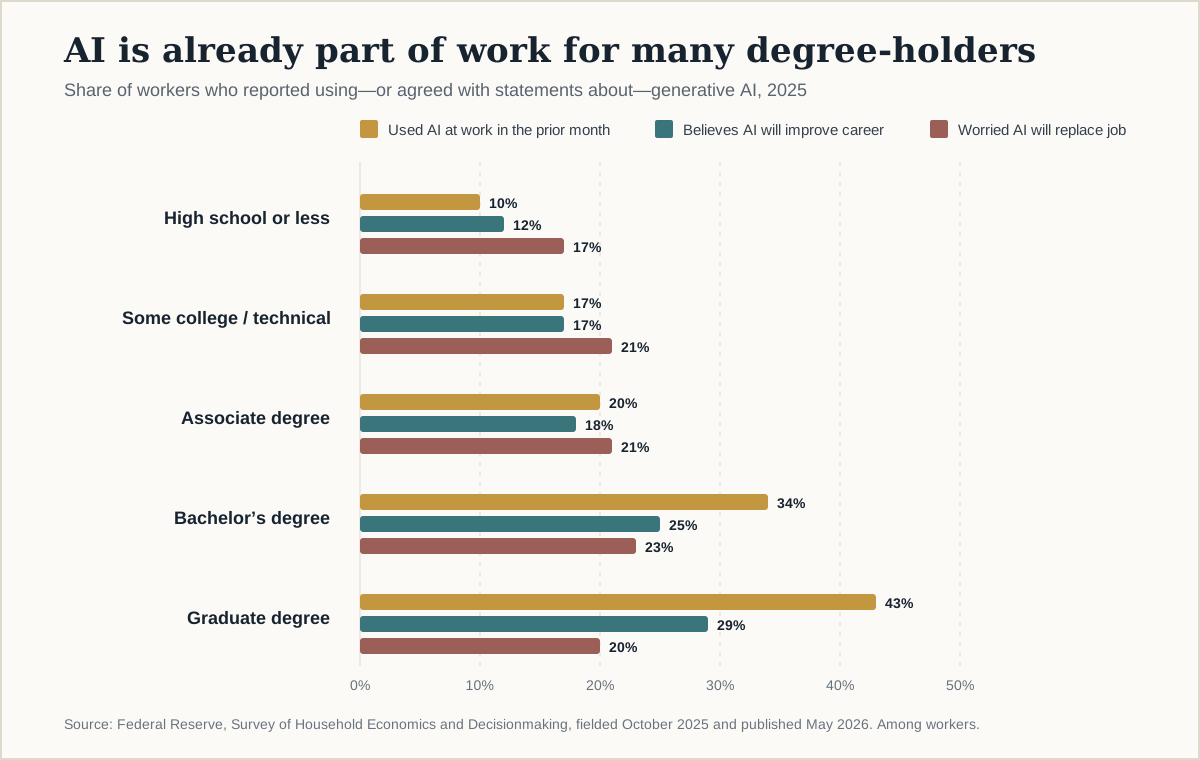
The available evidence calls for attention—not panic. The Federal Reserve found that one in four workers had used generative AI at work in the prior month. Use was much higher among workers with a bachelor’s degree (34%) or graduate degree (43%). These same workers were not uniformly pessimistic: 29% of graduate-degree workers believed AI would improve their career, while 20% worried that it would replace their job. (Federal Reserve)
The Bureau of Labor Statistics introduced occupation-level AI-exposure categories in August 2026, but it gives an important warning: exposure means that AI could assist with or perform some occupational tasks. It does not, by itself, measure job loss, productivity, automation probability, or wages. (BLS)
That distinction matters. A radiologist, engineer, attorney, professor, software developer, or financial professional may be highly exposed to AI because the technology can participate in parts of the work. Exposure could reduce demand for some tasks, increase the output expected from each person, create new services, or make human judgment more valuable in the highest-stakes moments. The job title alone does not reveal which effect will dominate.
| Evidence | Reasonable conclusion | Conclusion to avoid |
|---|---|---|
| High occupational AI exposure | Many tasks could be assisted or completed with AI. | The entire occupation will disappear. |
| Rising workplace adoption | AI literacy is becoming relevant to more professional roles. | Every user will become more productive or secure. |
| Weaker early-career outcomes in some exposed work | Entry paths and junior task bundles may be changing. | AI alone caused every observed hiring change. |
| Growth in AI-related investment and services | New demand, roles, and complementary skills can emerge. | Benefits will reach every industry and worker evenly. |
Stanford’s current Canaries Dashboard finds modest differences across AI-exposure groups in its large ADP payroll sample. The most visible weakness appears among workers ages 22–25 in the two most-exposed occupational groups; the pattern becomes less stark and eventually disappears among older workers. Stanford explicitly describes this as correlation in a nonrepresentative sample—not proof that AI caused the employment changes. (Stanford Digital Economy Lab and ADP Research)
A September 2026 Stanford working paper adds another useful nuance. Using 1.25 billion job postings and 154 million employment records across 41 countries, the researchers found that AI-adopting firms reduced the junior share of their workforce relative to comparable firms. The change came mainly from faster growth in senior employment—not a broad collapse in junior employment—and the results suggested modest overall employment and productivity gains. (Stanford Digital Economy Lab)
A slower-moving labor market raises the price of interruption
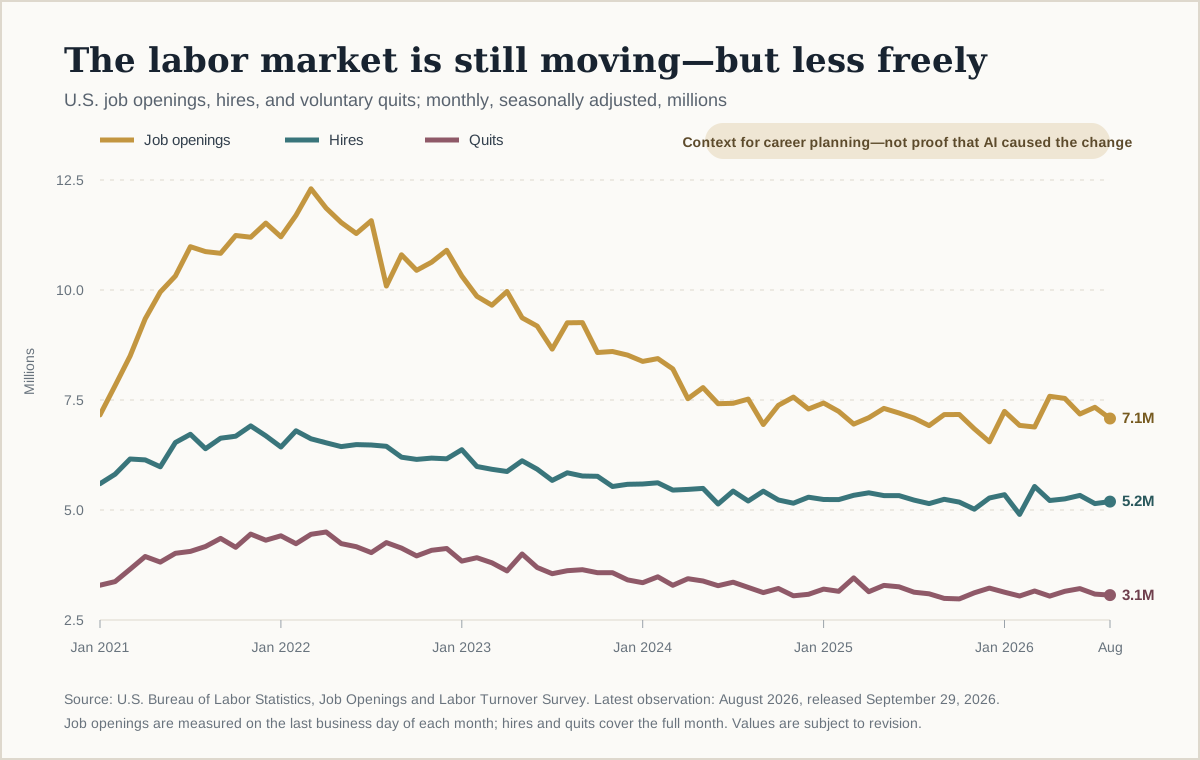
The national labor market is not in free fall. The unemployment rate was 4.2% in September 2026, and payroll employment increased by 29,000. But the market is less fluid than it was during the 2021–22 hiring boom. August 2026 had 7.1 million job openings, 5.2 million hires, and 3.1 million voluntary quits. Openings were approximately 42% below their March 2022 peak, and quits were approximately 32% below their April 2022 peak. (BLS JOLTS)
For financial planning, the most important variable may be neither the unemployment rate nor the probability of permanent displacement. It may be transition time. In September, 1.9 million people had been unemployed for 27 weeks or longer—27.1% of all unemployed people. That figure covers the entire labor market, not specifically highly educated professionals, but it is a useful reminder that a job search can last longer than expected. (BLS Employment Situation)
A professional who finds another position in three weeks faces a different financial event from one who needs nine months to locate a role with comparable compensation, benefits, seniority, and geography. A resilient plan does not need to predict which outcome will occur. It needs to keep both outcomes manageable.
The good news: change also creates demand
Technological change does not move every occupation in the same direction. BLS projects that total U.S. employment will grow 3.5% from 2025 to 2035, adding 5.9 million jobs. The professional, scientific, and technical services sector is projected to grow 8.6% and add approximately 926,700 jobs, partly because of demand for AI systems, research, development, and consulting. Computing infrastructure and data-processing services are projected to grow 25.1%. (BLS Employment Projections)
This is an encouraging point. Your career is not a fixed security whose value is set by a single forecast. It is a living asset that can be renewed. New tools can reduce the value of one task while expanding the reach of another. The professional who learns to use AI responsibly, verify its work, explain difficult judgments, and connect technical output to human needs may become more—not less—valuable.
Five ways career change can enter a financial plan
Task risk
Your occupation may remain, but the mix of valuable tasks can change. Routine production may matter less; verification, judgment, integration, and accountability may matter more.
Transition-time risk
A comparable role may take longer to secure, especially when seniority, location, specialization, or compensation narrows the field.
Compensation risk
Base salary, bonus, equity awards, promotion speed, or consulting rates can change before a job disappears.
Concentration risk
Salary, employer stock, benefits, deferred compensation, professional identity, and network may all depend on one organization or industry.
Career-duration risk
A late-career disruption can turn a planned retirement date into an unplanned one, reducing savings years and increasing withdrawal years at the same time.
Same salary, different resilience
Consider two hypothetical professionals who each earn $220,000 and experience a nine-month interruption. Their income is identical before the interruption; their ability to navigate it is not.
| Planning factor | Professional A | Professional B |
|---|---|---|
| Annual salary before interruption | $220,000 | $220,000 |
| Essential monthly outflow | $10,000 | $7,500 |
| Dedicated liquid reserve | $50,000 | $90,000 |
| Transition runway | 5 months | 12 months |
| Employer stock as share of investable assets | 28% | 6% |
| Benefits-transition plan | Not documented | Coverage choices and deadlines documented |
| Professional option set | Network concentrated inside employer | External relationships and current skills portfolio |
| Position after nine months* | $40,000 funding gap | $22,500 reserve remaining |
Illustration only. Assumes no severance, unemployment benefits, investment return, taxes, partner income, spending changes beyond the stated essential outflow, or unexpected costs. “Employer stock” is included to illustrate correlated risk, not to suggest a universal allocation limit. Actual planning depends on household resources, taxes, benefits, job prospects, risk tolerance, and other circumstances.
The lesson is not that every professional needs twelve months of cash or must reduce spending to a particular level. It is that income alone does not buy career freedom. Liquidity, expense flexibility, diversification, insurance, and professional portability determine how long someone can search thoughtfully instead of accepting the first available option.
The CAREER resilience framework
The purpose is not to build a bunker around your career. It is to create enough room to keep learning, negotiating, and choosing. A useful review can follow six steps:
Clarify task exposure
List the work you do—not merely your title. Which tasks can AI accelerate, which require verification, and which depend on trust, context, accountability, persuasion, or physical presence?
Audit employer dependencies
Map everything tied to the organization: salary, bonus, equity, health coverage, disability insurance, life insurance, retirement match, deferred compensation, visa status, and professional network.
Reserve time
Estimate essential monthly outflow and calculate runway under three-, six-, twelve-, and eighteen-month transitions. Give liquidity a defined career-resilience job.
Expand portable capital
Invest in skills, credentials, relationships, visible work, and a reputation that travel with you. The best development plan connects learning to problems employers or clients will pay to solve.
Examine protection
Understand what happens to health insurance, disability coverage, life insurance, stock awards, retirement benefits, and deferred compensation when employment ends.
Rehearse the transition
Identify the first five calls you would make, documents you would need, costs you could pause, and work you could pursue. A plan practiced calmly is easier to use under pressure.
A 30-minute career-resilience review
You do not need a forecast of the labor market to take a useful next step. Set aside thirty minutes and write down honest answers to these questions:
- Which three parts of my work create the most distinctive value? Focus on outcomes, not activities.
- Which tasks are becoming easier to automate or delegate? Decide whether to automate them, move up the value chain, or deepen a complementary skill.
- How many months of essential spending can my household cover without my paycheck? Separate dedicated liquidity from assets you would be reluctant or tax-inefficient to sell.
- How much of my financial life depends on the same employer? Include stock, bonus, benefits, insurance, deferred compensation, and network—not salary alone.
- When did I last build a professional relationship outside my organization? A network created during calm periods is more authentic and useful than one assembled during urgency.
- What would make me more useful alongside AI one year from now? Choose one concrete capability that combines technology with domain expertise and judgment.
- If work changed unexpectedly, what would I want the freedom to say no to? This question turns financial resilience into something positive: protection of standards, purpose, and choice.
Sources and methodology
- Board of Governors of the Federal Reserve System, Employment and Job Quality—Report on the Economic Well-Being of U.S. Households in 2025 (May 2026). The survey was fielded in October 2025.
- U.S. Bureau of Labor Statistics, The Employment Situation—September 2026 (October 2, 2026).
- U.S. Bureau of Labor Statistics, Job Openings and Labor Turnover—August 2026 (September 29, 2026). The line chart uses monthly seasonally adjusted total-nonfarm series for job openings, hires, and quits from January 2021 through August 2026.
- U.S. Bureau of Labor Statistics, Artificial Intelligence Exposure Categories (August 27, 2026).
- U.S. Bureau of Labor Statistics, Employment Projections, 2025–2035 (August 27, 2026).
- Stanford Digital Economy Lab and ADP Research, AI Economic Indicators: Canaries Dashboard (accessed October 3, 2026).
- Bharat Chandar and Bouke Klein Teeselink, Stanford Digital Economy Lab, How Does AI Change Labor Demand? Evidence from 41 Countries (September 21, 2026).
Labor-market estimates are subject to revision. National statistics do not predict an individual profession, employer, or job search. The Stanford dashboard uses a large but nonrepresentative balanced sample of firms using ADP payroll services and measures correlations rather than a causal effect. All percentage changes and scenario calculations in this article use unrounded inputs and are rounded only for display. Data were reviewed through October 3, 2026.