

Every fall, many accomplished professionals make some of their most consequential financial decisions between meetings, after dinner, or five minutes before an enrollment portal closes.
The screen may ask for a health plan, an HSA contribution, life and disability coverage, retirement elections, and beneficiaries. Because each choice appears in a separate box, it is easy to treat the process as an administrative chore. But the boxes are connected. A health-plan deductible affects liquidity. Disability coverage protects the income funding retirement. A beneficiary form directs assets to people you care about. Employer contributions are compensation—even when they never appear in your checking account.
Open enrollment does not require a perfect forecast of next year. It requires a better set of questions.
Do not ask only, “Which benefit is cheapest?” Ask, “Which combination helps my household absorb risk, use tax advantages, and keep more choices open?”
Four current numbers worth slowing down for
Sources: U.S. Bureau of Labor Statistics, KFF, and Internal Revenue Service. *The deductible estimate applies to covered workers in plans with a general annual deductible, not every worker. KFF’s 2025 survey is the latest completed national Employer Health Benefits Survey available as of October 11, 2026.
Your benefits are part of your compensation
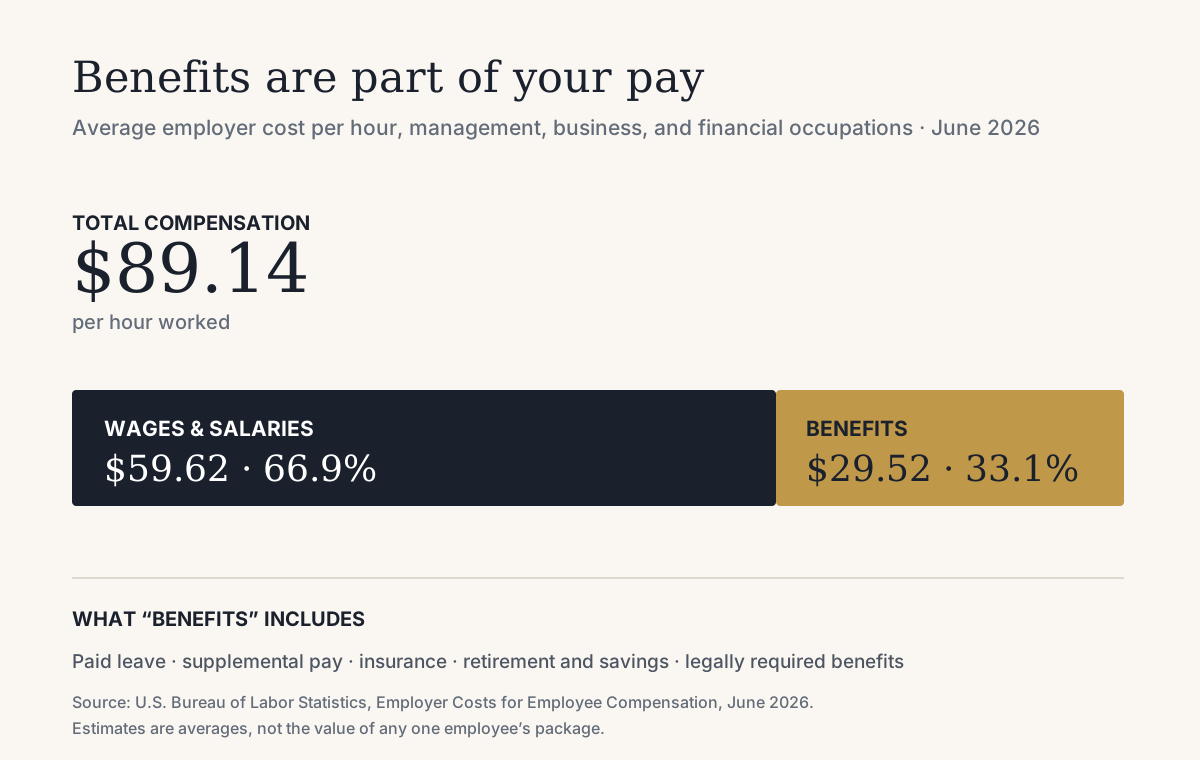
The word salary is often used as shorthand for compensation, but it captures only part of what an employer spends. In June 2026, the Bureau of Labor Statistics estimated average employer compensation costs of $89.14 per hour for management, business, and financial occupations. Wages and salaries represented $59.62; benefits represented $29.52, or 33.1%. Benefits in the BLS measure include paid leave, supplemental pay, insurance, retirement and savings, and legally required benefits. (BLS)
That does not mean every professional receives benefits worth exactly one-third of pay. It does mean that ignoring the package can leave a large part of compensation unexamined.
1. Compare health plans by total exposure—not premium alone
The lowest payroll deduction is not automatically the least expensive plan. A premium is the price of having coverage. The deductible, copayments, coinsurance, prescription rules, and out-of-pocket maximum help determine what happens when you use it. The provider network determines whether the clinicians and facilities you value participate at favorable rates.
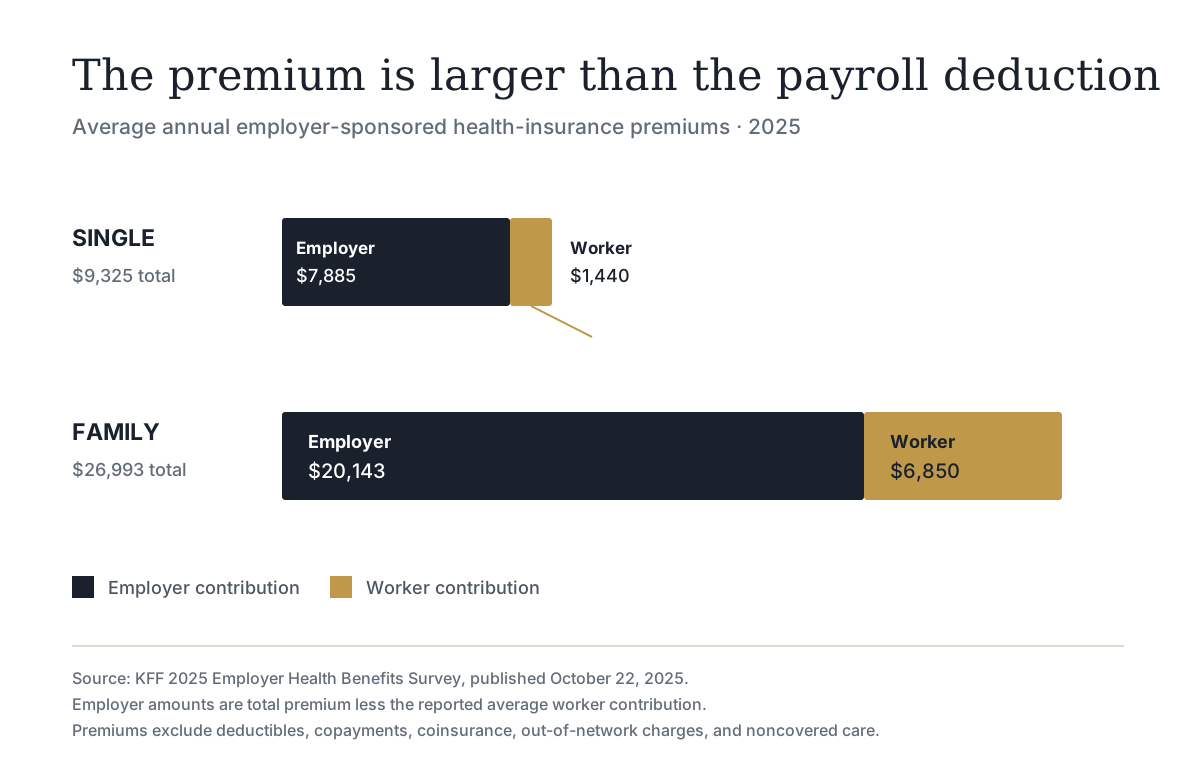
KFF’s latest completed employer survey reported average 2025 annual premiums of $9,325 for single coverage and $26,993 for family coverage. Workers paid an average of $1,440 and $6,850, respectively; employers funded the balance. Among workers with single coverage and a general annual deductible, the average deductible was $1,886. (KFF)
This is a planning screen, not a prediction. It excludes out-of-network and noncovered care and assumes employer HSA or HRA funding is available and usable for the relevant expense. A plan’s governing documents control.
| Question | Why it matters | Where to verify |
|---|---|---|
| What is the annual employee premium? | This is the predictable cost—even in a year with no claims. | Enrollment portal or rate sheet |
| What are the deductible and out-of-pocket maximum? | They show different layers of cost sharing and potential in-network exposure. | Summary of Benefits and Coverage |
| What does the employer contribute? | HSA or HRA funding can materially change the net economics. | Employer contribution schedule |
| Are our clinicians, facilities, and medications covered? | A lower-cost plan can become expensive or disruptive when important care is out of network or excluded. | Current provider directory and drug formulary |
| How is family cost sharing structured? | An embedded individual deductible behaves differently from one aggregate family deductible. | Plan document or carrier confirmation |
| Could we fund an early-year claim? | The annual arithmetic may work while the January cash-flow timing does not. | Household liquidity review |
The Department of Labor distinguishes the short, standardized Summary of Benefits and Coverage from the more complete Summary Plan Description. The second document explains rights, responsibilities, claims, and how the plan operates. If an important answer is missing from the enrollment screen, ask for the governing documents. (U.S. Department of Labor)
2. Decide whether an HSA or FSA has a job in your plan
An HSA is not simply a checking account for copayments. For eligible individuals, contributions may receive favorable tax treatment, earnings can accumulate tax-deferred, and distributions for qualified medical expenses may be tax-free. The account is individually owned and can remain with you after changing employers. Eligibility rules still matter, and enrollment in Medicare generally ends HSA contribution eligibility. (IRS Publication 969)
| Federal limit | 2026 self-only | 2027 self-only | 2026 family | 2027 family |
|---|---|---|---|---|
| HSA contribution limit | $4,400 | $4,500 | $8,750 | $9,000 |
| Minimum HDHP deductible | $1,700 | $1,750 | $3,400 | $3,500 |
| Maximum HDHP out-of-pocket amount | $8,500 | $8,700 | $17,000 | $17,400 |
Sources: IRS Revenue Procedures 2025-19 and 2026-24. HSA contribution limits combine eligible employer and employee contributions. An eligible account holder age 55 or older may generally make an additional $1,000 catch-up contribution. Special rules and eligibility requirements apply.
The rules also expanded recently. Beginning in 2026, qualifying bronze and catastrophic individual-market plans are treated as HSA-compatible under the new provisions, certain direct-primary-care arrangements can coexist with HSA eligibility, and some direct-primary-care fees may qualify for tax-free HSA payment. Telehealth relief was also made permanent. These are technical rules—not a reason to assume every bronze, catastrophic, or primary-care arrangement works the same way—so confirm eligibility before contributing. (IRS)
A health FSA can be valuable for predictable eligible expenses, but unused amounts can be forfeited unless the employer’s plan permits a carryover or grace period. A general-purpose health FSA held by you—or sometimes your spouse—can also interfere with HSA eligibility. The simple question is not “HSA or FSA?” It is “Which account am I eligible for, what expenses will it cover, what happens to unused money, and how does it coordinate with the rest of the household?”
3. Treat disability coverage as paycheck insurance
For many professionals, the ability to earn is the engine behind the entire financial plan. Yet group disability coverage is often accepted without checking the replacement percentage, monthly cap, definition of disability, waiting period, benefit duration, exclusions, treatment of bonuses or equity compensation, and whether benefits may be taxable.
Social Security Disability Insurance is not a substitute for understanding employer or individual coverage. Social Security generally requires an impairment that prevents substantial gainful activity and is expected to last at least 12 months or result in death; SSDI also generally has a five-month waiting period. (Social Security Administration)
A professional earning $240,000 may see “60% coverage” and assume $144,000 is protected. A monthly benefit cap, tax treatment, or definition applying only when the person cannot work in another occupation may produce a very different outcome. Read the certificate rather than relying on the percentage alone.
4. Size life insurance around people—not a salary multiple
Employer life insurance can be a helpful foundation, but a default multiple of salary does not know your mortgage, children, education goals, caregiving responsibilities, partner’s earning capacity, debts, existing assets, or estate plan. It may also become more expensive or unavailable after employment ends.
Ask what financial work the coverage must perform, for whom, and for how long. Then distinguish coverage you control personally from coverage dependent on the same employer that supplies your paycheck and health insurance. The goal is not to buy the largest number on the screen. It is to identify the gap honestly.
5. Coordinate retirement elections with taxes and employer dollars
Open enrollment and retirement-plan enrollment are not always the same process, and many plans allow contribution changes during the year. Still, annual benefits season is a useful checkpoint. Review the employer match formula, vesting schedule, current savings rate, pre-tax and Roth choices, investment allocation, outstanding loans, and whether a bonus election differs from regular payroll.
Begin with the match, but do not end there. A match can be valuable employer compensation; the right contribution type depends on current and expected future tax circumstances, available cash flow, plan design, and the role of other accounts. Avoid assuming that “Roth is always better” or “pre-tax is always better.” Tax diversification can be useful precisely because the future is uncertain.
6. Update beneficiaries before life updates them for you
Retirement accounts and employer insurance typically rely on beneficiary designations. Marriage, divorce, birth, death, or a changed family relationship can make an old form inconsistent with current intentions. Some retirement plans also provide spouses specific rights, and divorce orders can affect benefits. The Department of Labor advises participants to notify the plan of changes in marital status and to understand the plan’s beneficiary rules. (U.S. Department of Labor)
Check primary and contingent beneficiaries, exact legal names, allocations, and whether a trust or minor has been named without legal and tax review. Coordinate the forms with estate documents rather than assuming a will automatically controls every benefit.
7. Give voluntary benefits a purpose before giving them a premium
Accident, critical-illness, hospital-indemnity, legal-service, identity-protection, pet, and other voluntary benefits may be useful—but they solve different problems. A benefit can sound reassuring while duplicating existing protection or paying only under narrow conditions.
For each election, finish this sentence: “I am buying this because, if ___ happens, it will pay ___ and protect ___.” If the answer is unclear, read the exclusions and compare the premium with the financial risk retained. Small payroll deductions deserve the same intentionality as large ones because they repeat every pay period.
8. Make one household decision—not two employee decisions
When two partners have employer benefits, choosing independently can create waste or conflicts. Compare both employers’ premiums, spousal surcharges, employer contributions, networks, deductibles, out-of-pocket maximums, prescription coverage, HSA eligibility, FSAs, disability coverage, life insurance, and dependent-care benefits.
The “best” plan for one person may not be best for the household. One partner’s general-purpose health FSA may affect the other partner’s HSA eligibility. Putting everyone on one medical plan may simplify administration but cost more than split coverage. A dependent-care election must reflect realistic eligible expenses and current federal rules. Coordination is where many of the most valuable decisions live.
A simple illustration: the lowest premium is only a starting point
Consider two hypothetical self-only options. The table does not predict medical spending or show which plan is better; it demonstrates why the premium alone cannot answer the question.
| Planning input | Lower-premium HSA option | Higher-premium option |
|---|---|---|
| Employee premiums | $3,000 | $6,600 |
| Deductible | $2,000 | $750 |
| In-network out-of-pocket maximum | $7,500 | $4,000 |
| Employer account contribution | $1,000 to HSA | $0 |
| Potential annual cash exposure* | $9,500 | $10,600 |
Illustration only. *Employee premiums plus the in-network out-of-pocket maximum, less stated employer funding. The calculation excludes out-of-network and noncovered care, assumes the employer contribution is available for eligible costs, and ignores tax effects. Actual plan value depends on covered care, negotiated prices, timing, network, prescriptions, family structure, tax eligibility, and plan terms.
The HSA option in this illustration has a higher deductible but a lower stated worst-case cash exposure because its premium is lower and the employer contributes to the account. In a different employer’s plan, the result could reverse. Even here, a person with ongoing specialists or expensive prescriptions might reasonably prefer the other network or formulary. The right conclusion is not “choose the HSA.” It is “do the whole comparison.”
Your 30-minute open-enrollment review
- Download the documents. Save the plan comparison, Summary of Benefits and Coverage, Summary Plan Description, insurance certificates, rates, and confirmation statement.
- Calculate annual premiums. Convert every per-paycheck deduction into an annual amount using the correct number of pay periods.
- Compare a normal year and a difficult year. Include premiums, expected care, employer account funding, and the in-network out-of-pocket maximum.
- Verify the details that matter personally. Check clinicians, facilities, medications, planned procedures, therapy, fertility, mental-health care, and travel needs directly.
- Review income protection. Record disability replacement percentage, cap, waiting period, duration, definition, exclusions, and likely tax treatment.
- Review family protection. Identify what employer life insurance would actually cover and whether it is portable.
- Capture employer dollars. Note matches, HSA/HRA contributions, wellness incentives, education benefits, and deadlines.
- Confirm beneficiaries and save proof. Review both primary and contingent designations and retain the dated confirmation.
Then place one reminder on the calendar for midyear. Benefits should be reviewed again after a marriage, divorce, birth, death, job change, major diagnosis, approaching Medicare eligibility, or another qualifying event. Annual enrollment is a checkpoint—not the only moment financial planning matters.
Sources and data notes
- U.S. Bureau of Labor Statistics, Employer Costs for Employee Compensation—June 2026 (released September 9, 2026).
- KFF, 2025 Employer Health Benefits Survey (published October 22, 2025; latest completed annual survey available as of this article’s publication).
- Internal Revenue Service, Revenue Procedure 2025-19 (2026 HSA and HDHP amounts).
- Internal Revenue Service, Revenue Procedure 2026-24 (2027 HSA and HDHP amounts).
- Internal Revenue Service, Guidance on expanded HSA availability (Notice 2026-05 summary).
- Internal Revenue Service, Publication 969: Health Savings Accounts and Other Tax-Favored Health Plans.
- U.S. Department of Labor, Health-plan information and Summary Plan Descriptions.
- Social Security Administration, Disability eligibility.
- U.S. Department of Labor, What You Should Know About Your Retirement Plan.
National averages describe groups, not an individual employee or plan. Plan documents, employment terms, tax rules, and personal circumstances control individual outcomes. Figures and rules were reviewed through October 11, 2026.